
Serving The Greater Midwest Region
Fire & Smoke Damper Testing and Inspection
Fire and smoke dampers help limit the spread of fire and smoke through a building’s ductwork and air-transfer openings. Regular inspection and testing help identify dampers that may not operate as intended.
Triton Test Balance provides fire and smoke damper testing for commercial facilities. From locating dampers and mapping their positions to evaluating operation and addressing deficiencies, we help facility teams understand what needs attention.

Different dampers.
Different roles in building safety.
Fire dampers
Designed to close in response to heat, fire dampers help protect openings where ductwork passes through fire-rated assemblies.
Smoke dampers
Designed to restrict smoke movement, smoke dampers operate through an actuator and the building’s associated detection or control system.
Combination fire/smoke dampers
These assemblies provide both fire protection and smoke-control functions. Inspection and testing need to account for both roles.
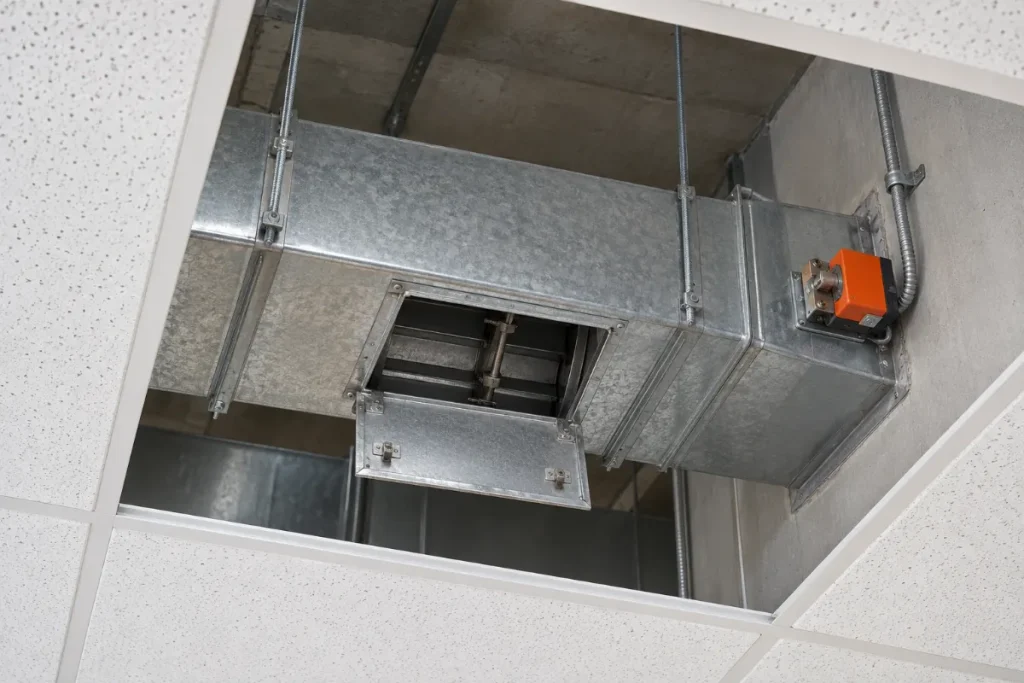
Hidden above the ceiling doesn’t mean working properly
A damper can remain out of sight for years. Damage, obstructions, deterioration, or problems with its operating components may prevent it from performing as intended.
Inspection and operational testing help identify concerns such as:
- Restricted movement: Debris or obstructions interfere with damper operation.
- Visible damage: Corrosion, damaged blades, or other deterioration need attention.
- Operating problems: Release mechanisms or actuators do not function as intended.
- Access limitations: The damper cannot be reached adequately for inspection or testing.
The appropriate checks depend on the damper type, manufacturer’s instructions, and applicable requirements.
How often should fire and smoke dampers be tested?
New installation
Initial operational or acceptance testing, followed by inspection and testing one year later.
Most buildings
Recurring inspection and testing generally every four years.
Hospitals
Recurring inspection and testing generally every six years.
The hospital interval should not automatically be applied to every healthcare, assisted living, or retirement facility. Confirm the schedule against the building’s classification, adopted standards, manufacturer’s instructions, and authority having jurisdiction—the official responsible for enforcing applicable requirements.
Dampers associated with smoke-control systems can have additional testing requirements.
Start with the dampers—and the records you already have
Whether you manage a hospital, senior living community, or another commercial building, a useful starting point is understanding what is installed, when it was last tested, and which issues remain unresolved.
PREPARING FOR YOUR DAMPER INSPECTION
Missing records? Tell us what you have so we can discuss the appropriate starting point.
Plan your next fire and smoke damper inspection
Tell us about your facility, previous testing, and any upcoming deadlines. We’ll discuss your inspection needs and the next steps for your building.
Discuss Your Damper Inspection866-874-8662Common Questions
No. Fire dampers respond to heat to help protect fire-rated openings. Smoke dampers restrict smoke movement. Combination fire/smoke dampers perform both functions.
Appearance alone does not establish that a damper will operate correctly. Applicable inspection and testing procedures also evaluate operation according to the damper type and relevant requirements.
An access problem needs to be identified and addressed so the required work can be completed. Share known access limitations when discussing the inspection scope.
If testing identifies a problem, the finding should be documented and the appropriate corrective action determined. We provide fire damper repairs and can discuss the repair scope and any follow-up testing your facility needs.